Posture Improvement
Seated Stretches for Sustained Spinal Awareness
Tobias Marsden·
Before the day acquires its noise, there is a window of particular usefulness. It is not large — perhaps ten minutes, perhaps twenty — and it exists in the uncertain territory between sleep and full wakefulness, when the body has not yet committed itself to the postures of the hours ahead. A considered stretch sequence occupies that window without demanding anything dramatic from muscles that are not yet warm, joints that have not yet been asked to perform.
This article is concerned with what a morning stretching sequence actually is, structurally: what it asks of the body, why the ordering of its elements matters, and how the sequence as a whole can be arranged so that it serves as a consistent daily foundation rather than an occasional ambition.
A body that has been horizontal for seven or eight hours is, in several measurable senses, different from the same body after an hour of vertical movement. Synovial fluid — the substance that lubricates joints — distributes more uniformly through joint spaces following movement. Muscle temperature, which affects the tissue’s response to lengthening, is lower in the morning than at midday. The fascia, the connective tissue that surrounds and interpenetrates muscle groups, tends toward relative stiffness after prolonged stillness.
None of this constitutes a problem. It is simply the physical context within which a morning sequence operates. Understanding it is useful because it shapes the appropriate character of that sequence: movements should be gradual, ranges of motion should be entered slowly, and the body should be allowed to respond rather than driven through positions that require effort it is not yet ready to produce.
The distinction between a morning sequence and an afternoon practice is partly thermal. In the afternoon, after hours of walking, sitting, and generally moving through a day, the body arrives at a mat already somewhat warm — ready for poses that require more of the hip flexors, hamstrings, or shoulder girdle. In the morning, this pre-warming has not occurred. A well-designed morning sequence acknowledges this by beginning with what might be called the body’s default poses: gentle spinal mobilisation, soft hip opening, and breath-coordinated movement.
The metaphor of architecture is not incidental here. A stretch sequence has a structure — a logic of ordering that determines whether the session feels coherent or arbitrary. Arriving at a mat and performing stretches in whatever order occurs to one is not sequencing; it is a collection of individual poses. What distinguishes a sequence is the relationship between its parts: each element prepares for or responds to the previous one.
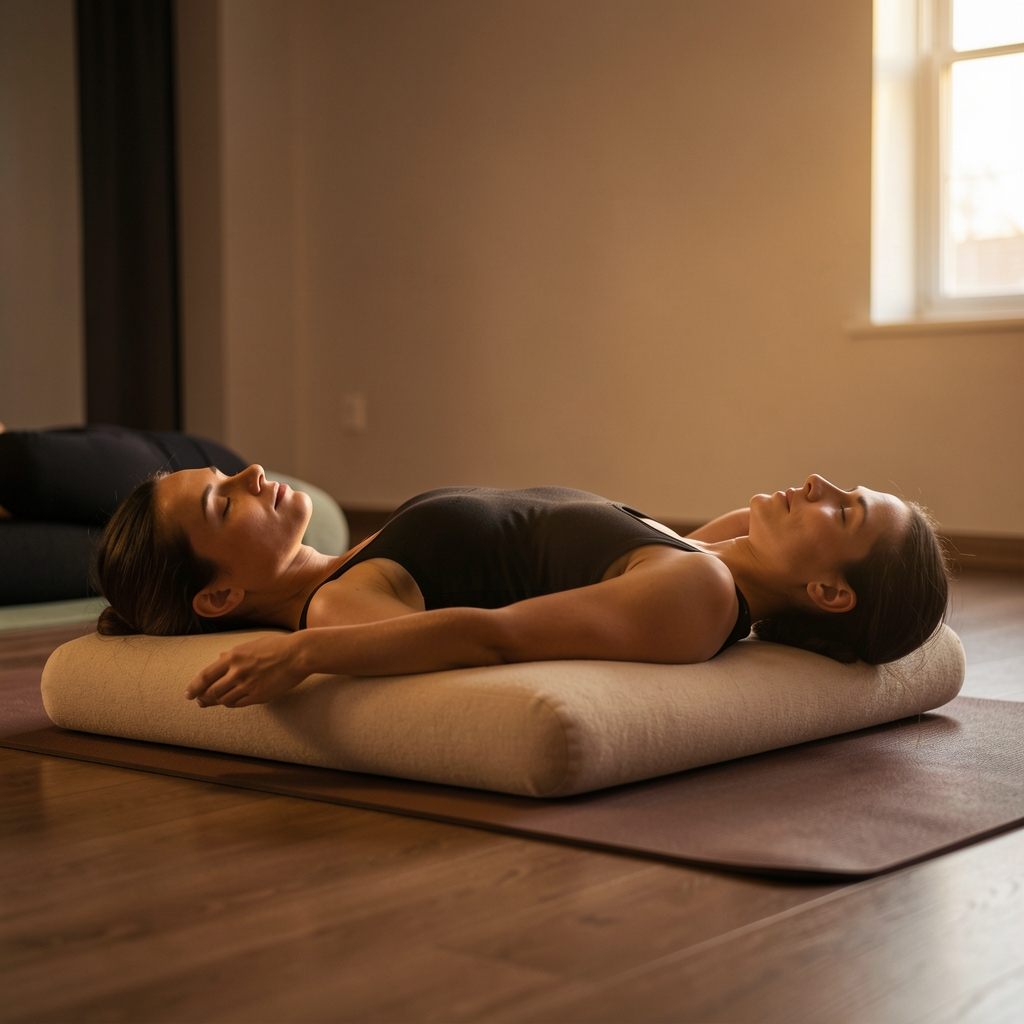
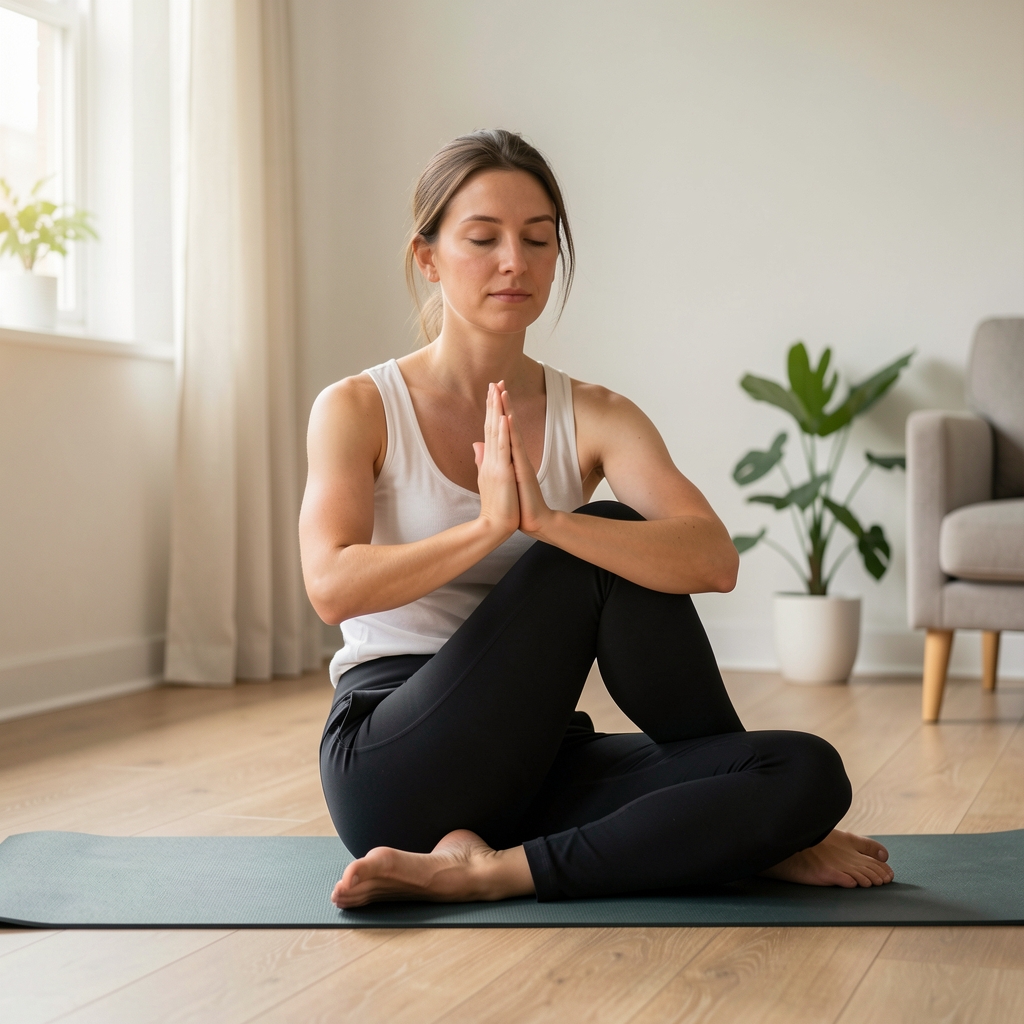
In practice, a morning sequence might be understood as having three phases. The first is mobilisation: gentle movement of the joints through their available range — circling the ankles, rolling the shoulders, rotating the neck — without attempting to extend that range. The second is graduated lengthening: poses that begin to work on the muscle groups most implicated in the day’s likely activities, entered slowly and held with attention to breath. The third is consolidation: a transition to stillness, often in a seated or supine position, that allows the nervous system to register the changes that have been introduced.
This three-phase structure does not require sophisticated knowledge of anatomy. It requires only the patience to move through one phase before entering the next, and the discipline not to skip the consolidation phase because the day has already begun to press.
Breath work is not an addition to a morning stretch sequence — it is the medium through which the sequence operates. The quality of a held pose changes considerably depending on whether the breath is shallow and held or full and moving. In a forward fold, for instance, an exhale tends to allow the spine and hamstrings to release a fraction further into the position than the breath held or drawn in. This is not a technique; it is the body’s ordinary physiology being engaged rather than overridden.
A morning sequence that attends to breath from its first movement trains something more than flexibility. It trains the relationship between conscious attention and physical sensation — a relationship that proves useful throughout the day in a range of contexts that have nothing to do with yoga. The ability to notice and modulate one’s own tension, fatigue, or reactivity through breath is not a spiritual claim. It is a practical skill developed through repetition.
In the first few weeks of a daily morning practice, many people report that they find it difficult to sustain attention on breath throughout even a ten-minute sequence. The mind moves toward the day ahead — the first obligation, the unread messages, the decision that could not be deferred. This is not a failure of the practice; it is the practice’s first territory. Noticing where the attention has gone and returning it, gently, to the breath is the fundamental act that makes a morning sequence different from merely performing a set of shapes.
Among the muscle groups most commonly addressed in a morning sequence, the hips merit particular attention. Hip flexibility — specifically the range of motion available in external hip rotation and hip flexion — is reduced after prolonged sitting and responds well to consistent daily attention. Published research in exercise physiology suggests that static stretching performed regularly over weeks produces measurable increases in range of motion, with effects that accumulate gradually rather than appearing after any single session.
A morning sequence that includes two or three hip-opening shapes — a low lunge variation, a pigeon-adjacent position, or a figure-four stretch supine — addresses this area at the moment when the body is most amenable to it: before the sitting of the working day has reinforced the positions it is being asked to counter.
The key is graduated entry. A hip opener performed immediately after waking, with tight connective tissue and low muscle temperature, must be entered more slowly than the same pose performed after an hour of movement. Forcing range of motion in the morning is not only uncomfortable; it is counterproductive, as the body’s protective responses will resist rather than release.
The effects of a daily morning stretching practice are not dramatic in any single session. They accumulate. Over months, practitioners consistently report changes in the quality of their standing and seated posture — a greater ease in maintaining length through the spine without effortful correction, a reduction in the characteristic rounding of the shoulders that develops in those who work at screens. These are not definitive findings in any specialist sense; they are the observations of people paying attention to their own bodies over time.
What the research on habitual movement practice does suggest is that the mechanism is neural as much as muscular. The nervous system learns which positions are available and which are not through repeated experience. A daily practice that consistently visits a set of positions — even modestly — expands the nervous system’s map of what the body can do. Over time, these positions become more available, and the effort required to access them decreases.
This is the quiet logic of a morning sequence. It does not promise results in a compressed timeframe. It operates on the premise that a body asked to move attentively for ten minutes every morning will, in the course of a year, become a somewhat different kind of instrument — not transformed, but gradually more responsive, more at ease in the range it has been offered.
The question most often raised by those beginning a morning practice is not how to perform the poses correctly but how to perform them at all, consistently, in the face of a day that begins with competing demands. The answer does not lie in motivation, which fluctuates, but in architecture — the arrangement of conditions that make the practice more likely to happen than not.
Placing the mat the night before. Keeping the sequence short enough that it does not require negotiation with the available time. Beginning before the mind has fully engaged with the day’s agenda. These are not spiritual prescriptions; they are the practical mechanics of a sustainable daily habit, applicable to any activity one wishes to perform reliably across months and years.
A ten-minute morning sequence performed every day for a year contains approximately sixty hours of practice. That is more than most people who describe themselves as interested in yoga accumulate across two or three studio classes per week, once the weeks when attendance drops are accounted for. The morning sequence’s virtue is not its drama but its persistence.

Eleanor has practised yoga for eleven years and holds a postgraduate qualification in sports science. She writes on the intersection of movement science and everyday practice, with particular interest in flexibility training and morning routines.
More from this author →