Morning Flow
The Quiet Architecture of a Morning Stretching Sequence
Eleanor Whitfield·
There is a quiet argument to be made for the poses that do the least. Within a yoga practice of any length, the restorative positions — those in which the body is supported by props and asked to release rather than engage — are frequently the last to be taken seriously and the first to be abbreviated. They are, in the economy of a practice that prizes visible effort, easy to overlook. They are also, by a considerable margin, among the most productive elements of a sustained flexibility routine.
This article concerns the logic of restorative practice — what it is, what it does, and why its characteristic quietness should not be mistaken for absence of effect. The focus is practical: how restorative shapes fit into an existing movement routine, what props make them more accessible, and how the quality of breath during a held restorative pose determines much of what the pose accomplishes.
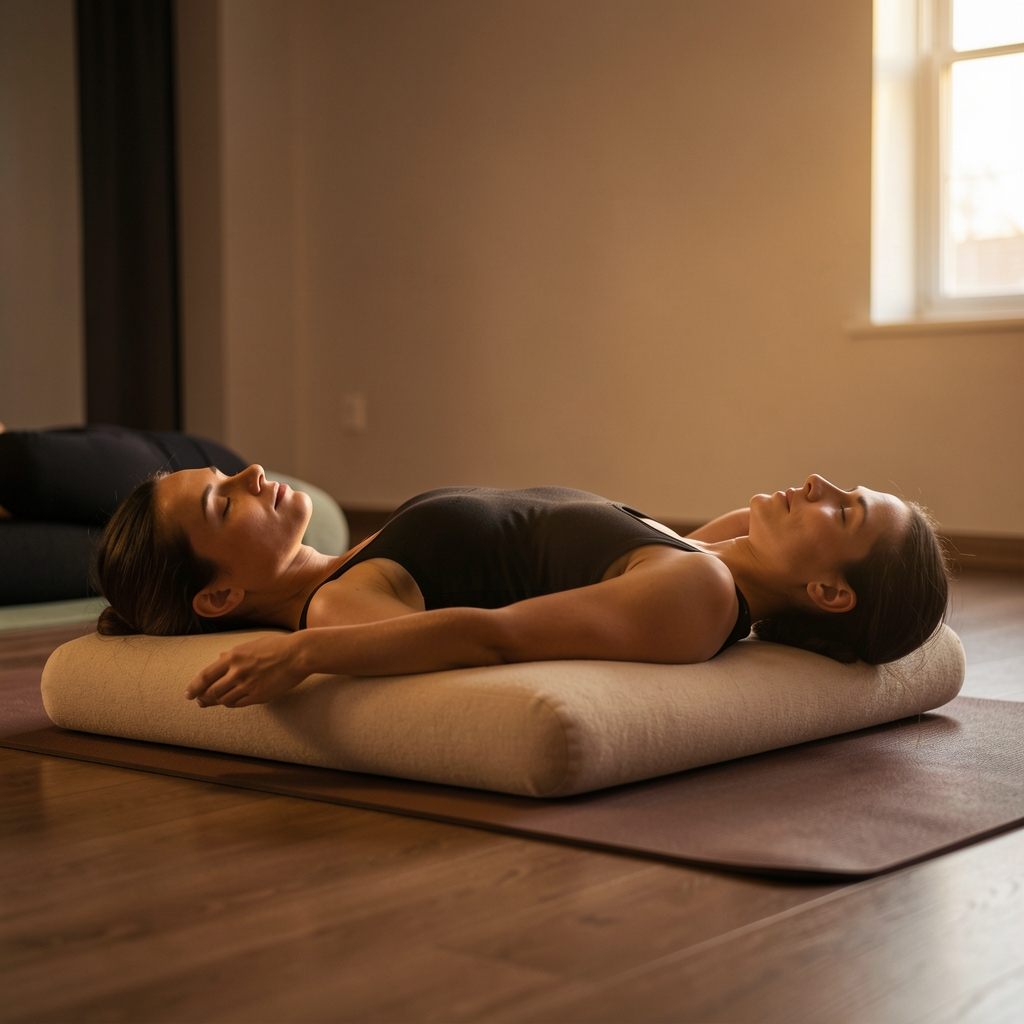
Restorative yoga is, in its structural essence, a set of poses held for extended periods — typically three to ten minutes — in positions where the body is fully supported and where no muscular effort is required to maintain the shape. The defining characteristic is the support: bolsters, folded blankets, blocks, and straps are used to bring the ground to the body, rather than requiring the body to reach the ground through effort. In a properly supported restorative position, every muscle in the body should be able to release.
This is a different physical proposition from a stretch. In a conventional stretch, the lengthening of a muscle group is achieved through some degree of tension — the practitioner moves into a range and holds it while the nervous system registers the position and, over time, allows greater access to that range. In a restorative position, the objective is the absence of that tension: the body is arranged in a shape, supported so that no effort is required to maintain it, and then left to settle into that shape over a period of minutes. The effect is produced by time and support, not by effort and range.
The distinction matters because it describes a different mechanism. Conventional stretching works primarily on the muscular system — on the length and responsiveness of muscle fibres and their fascial wrappings. Restorative practice works on the nervous system — on the body’s habitual level of background muscular tension and on the relationship between the breath and that tension. These are complementary, not competing, mechanisms. A movement routine that includes both conventional stretching and restorative practice addresses a broader range of the structures involved in flexibility and joint mobility than one that relies on stretching alone.
The body’s habitual muscular tension — the background level of contraction that muscles maintain even when they are not actively being used — is regulated by the nervous system. In most adults with sedentary working lives, this background tension is elevated in the muscles of the neck, upper back, hip flexors, and jaw, among others. This elevation is not dangerous; it is the nervous system’s reasonable response to the postural and attentional demands of the working day. But it represents a baseline from which any stretching practice must work, and a baseline that does not reset between sessions without deliberate intervention.
Restorative practice provides that intervention. The extended hold, combined with supported positioning and deliberate breath work, signals to the nervous system that the conditions for full muscular release are present. This signal does not arrive immediately — hence the three-to-ten-minute hold times. In the first minute of a restorative pose, most practitioners report that the body has not yet begun to release. The mind is still processing the day, the muscles are still holding their working-day tension, and the breath is still shallower than it will become. The release, when it comes, arrives gradually — and typically accelerates in the second half of a long hold.
What is being practised in a restorative pose, therefore, is not flexibility in the conventional sense. It is the ability to allow the nervous system to shift register — from the vigilance and readiness of working life to the quieter state in which the body can release what it has been holding. This is a trainable capacity. Practitioners who practise restorative shapes regularly report that this shift arrives more readily over time — that the body learns, with repetition, how to find the restorative state more quickly.
The breath is not incidental to restorative practice; it is its primary instrument. In a held restorative position — a supported bridge, a reclined bound angle, a legs-up-the-wall variation — the breath has the opportunity to move through the body in ways that the uprightness and muscular engagement of active practice does not permit. The diaphragm, freed from the demands of maintaining balance or managing tension in adjacent structures, can expand more fully. The exhale, lengthened deliberately, activates the parasympathetic branch of the autonomic nervous system — the branch associated with rest and the release of background tension.
A practical breath work approach for restorative holds is deceptively simple: allow the inhale to arrive without effort, and extend the exhale to approximately twice the length of the inhale. In a five-second inhale, a ten-second exhale. This ratio does not need to be counted precisely; the general direction — a long, slow release of breath — is more important than the exact proportion. Over the course of a three-minute hold, this breath pattern will shift the nervous system’s register more reliably than any attempt to physically release the muscles through effort.
A note on what often happens in the first attempts at restorative practice: the mind, accustomed to the productive activity of more effortful poses, finds the stillness uncomfortable. Thoughts arrive densely. The body feels restless rather than quiet. This is not a sign that restorative practice is not working; it is the normal initial response to a practice that asks something the body and mind are not yet trained for. Persistence through the first several sessions — even if they feel unproductive — is what allows the practice to develop into something more useful.
The effectiveness of a restorative pose depends almost entirely on the quality of its support. A body that is not fully supported will compensate by maintaining muscular engagement — the opposite of the practice’s intention. The investment in understanding how to use props is therefore not peripheral to restorative practice; it is its foundation.
A bolster — a firm cylindrical or rectangular cushion — is the central prop of restorative practice. It is used to support the chest in backbends, the knees in reclined positions, and the torso in forward folds. In the absence of a purpose-made bolster, a tightly rolled blanket or a firm sofa cushion serves adequately. The criterion is firmness: a prop that compresses under the body’s weight does not provide the consistent support that allows the body to release into it.
Blankets are used for warmth — a body at rest loses heat more quickly than an active one — and for fine-tuning support. A folded blanket under the head in a supine position eliminates the neck tension that often prevents full release in reclined poses. A blanket draped over the body serves the additional function of signalling to the nervous system that rest, rather than activity, is the current mode.
The legs-up-the-wall position requires only a wall and, optionally, a folded blanket under the pelvis. It is one of the most accessible restorative shapes available, requiring no previous yoga experience and no specialised equipment. The effect of the inverted leg position on the venous return of blood from the lower limbs is noticeable after just five minutes: a reduction in the heaviness and fatigue that accumulates in the legs through a day of standing or sitting. For this reason, it is a particularly useful shape for those whose working days involve prolonged standing.
The question of where restorative practice fits within a broader movement routine is answered, in the approved yoga tradition, consistently: it comes last. A restorative shape placed at the beginning of a session — before the nervous system has been engaged by movement — provides less release than the same shape placed after a period of active practice, when the nervous system’s baseline tension has already been partially addressed by the preceding movement.
In a practical daily routine, this means that restorative poses occupy the final five to fifteen minutes of a session. In a ten-minute morning practice, this might be a single pose held for five to eight minutes — a supported child’s position or a reclined bound angle — following three or four minutes of more active movement. In a longer evening practice, it might mean three or four shapes held for three to five minutes each, providing a sustained transition from the activity of the day to the rest of the night.
For those building a daily practice from scratch, the instruction to hold a position for five minutes can feel like an unexpectedly large commitment relative to the simplicity of the shape. The temptation to release early — to decide, after ninety seconds, that the pose has done what it is going to do — is consistent and understandable. The evidence, in the experience of sustained practitioners, suggests that the most productive period of a restorative hold tends to begin around the two-minute mark. Releasing before that threshold is, structurally, like leaving a conversation just before it becomes interesting.
Among the joint complexes most responsive to restorative practice, the hips are particular. The hip joint — a ball-and-socket joint with the largest range of motion of any joint in the body — is surrounded by some of the most force-generating and habitually tense muscle groups: the hip flexors, the external rotators, the adductors, and the gluteal group. These muscles carry, collectively, a large portion of the habitual tension that accumulates in a day of sitting, standing, or activity.
Restorative hip openers — the reclined bound angle (supta baddha konasana), the reclined figure-four, the long-held pigeon — address these structures through the mechanism described above: support, time, and breath rather than effort and range. A reclined bound angle held for seven minutes with a bolster under the knees will address the adductors and hip flexors in a way that is complementary to, and distinct from, the effect of an active low lunge or standing pigeon. The two approaches are not interchangeable; the most comprehensive hip flexibility work is produced by a combination of both.
The practical takeaway for those whose hip flexibility is a primary concern is straightforward: active stretching and restorative holds are not alternatives. They address different aspects of the same structural objective, and a routine that includes both — even if the restorative component is only a single five-minute hold at the end of each session — will produce more sustained progress than one that uses only the active approach.
Evening restorative practice has a documented relationship with the quality of the sleep that follows it. The parasympathetic shift produced by extended holds and slow breath work — the same shift described earlier as the mechanism of nervous system release — is the same physiological direction as the preparation for sleep. A twenty-minute restorative practice performed in the hour before sleep does not guarantee better sleep; nothing does. But it creates conditions — a reduced background tension, a slower breath, a quieter autonomic state — that are more conducive to sleep than the habitual high-activation state that most people bring to the end of a working day.
The overlap between restorative yoga and established sleep-preparation practices is not coincidental. The long exhale, the supported reclined position, the deliberate withdrawal of attention from the cognitive demands of the day — these are the structural elements of any effective wind-down routine, whether it goes by the name of yoga or not. The restorative tradition offers a well-developed set of shapes and sequences within which these elements are embedded; their effectiveness does not depend on the yoga context in which they were developed.

Eleanor has practised yoga for eleven years and holds a postgraduate qualification in sports science. She writes on the intersection of movement science and everyday practice, with particular interest in flexibility training and morning routines.
More from this author →