Morning Flow
The Quiet Architecture of a Morning Stretching Sequence
Eleanor Whitfield·
The spine’s relationship with a working day is, structurally speaking, a series of small negotiations. Each hour of sitting asks something of the vertebral column that it was not designed to offer indefinitely — a sustained forward flexion, a lateral lean toward a screen, a collapse of the lumbar curve into the back of a chair. A set of seated stretches, introduced at intervals through that same day, is not a correction so much as a conversation: the spine being asked, periodically, whether it has anything to say about the position it has been maintaining.
This article examines the logic and practice of seated stretching — not as a floor-based yoga sequence requiring a mat and a cleared room, but as a practice that can be performed at a desk, on a chair, or cross-legged on a hard floor, using only what is already available. The observations here are informed by published research on spinal biomechanics and by the practical experience of practising in the ordinary conditions of a working life.
The lumbar and thoracic vertebrae respond differently to prolonged sitting. The lumbar region — the lower back — tends toward flexion when the pelvis tilts posteriorly, as it commonly does when a person has been seated for more than thirty minutes without deliberate postural adjustment. The thoracic region — the mid and upper back — tends toward excessive kyphosis: the characteristic rounding that makes a person look, viewed from the side, as though they are slowly folding toward the work in front of them.
Both of these tendencies are the body’s reasonable response to the conditions it has been given. Neither is a failure of will. They are postural adaptations, and like all adaptations, they can be met with counter-movement. The most useful counter-movements for the seated spine are: thoracic extension (opening the chest and drawing the shoulders back), lateral flexion (a side bend that lengthens the obliques and the lateral thoracic musculature), and axial rotation — the spinal twist that can be performed from any seated position and that addresses the rotational range of motion most commonly lost in sedentary working patterns.
These three movements do not require a yoga mat. They do not require changing clothes, leaving a desk, or allocating a significant block of time. They require, primarily, the decision to interrupt the working position for three to five minutes at regular intervals — and the knowledge of what to do during those minutes.
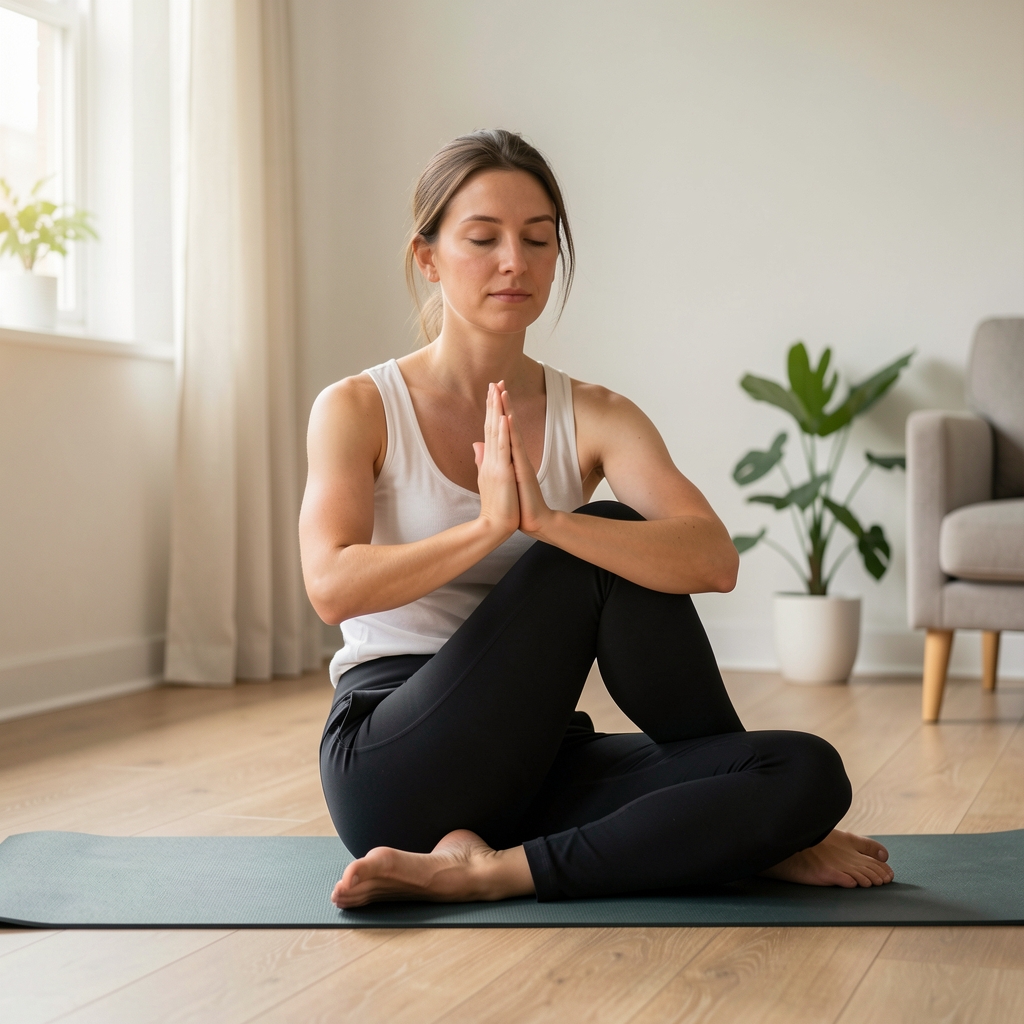
The seated spinal twist is among the most accessible of the counter-movements available to a person at a desk. Performed in a chair, it begins by grounding both feet on the floor and sitting forward slightly from the back of the seat. From this position, the practitioner rotates the torso to the right, placing the left hand on the outer right knee and the right hand behind the seat or on the back of the chair. The rotation is introduced slowly — not as a wringing motion, but as a gradual increase in the available range, aided by an exhale that tends to allow a fraction more movement than the inhale.
The important observational note here is that the quality of the twist is not measured by its range. A shallow twist performed with the spine long, the breath moving, and the shoulder girdle relaxed accomplishes more for the thoracic musculature than a deep twist performed with the breath held and the neck craned toward the direction of rotation. What the pose offers is not a competition with range; it is an invitation to notice what is happening in the spine as it moves — where the rotation encounters resistance, where it flows freely, where the natural breath assists the movement and where it seems to work against it.
The same twist performed seated cross-legged on a floor operates slightly differently. The anchoring of the pelvis to the ground, without the seat of a chair to provide a fixed base, means that the practitioner must attend more carefully to keeping the pelvis level. A tendency to allow one hip to lift during the rotation will reduce the effectiveness of the twist by transferring the movement from the spine to the hip joint. Cross-legged seated twists reward slower entry and greater attention to the base than chair-based versions do.
Side bends are, in most conventional movement practices, less prominent than forward folds or twists. They are also among the movements most consistently absent from a typical working day. The lateral flexors — the quadratus lumborum, the obliques, and the lateral fibres of the erector spinae — are rarely asked to lengthen significantly in desk-based postures. Their tightening is gradual, unremarkable, and consequential.
A seated side bend begins from the same grounded position used for the twist. The practitioner raises one arm above the head and tilts slowly to the opposite side, allowing the raised arm to extend the arc of the lateral flexion. The opposite hand may rest on the knee or the desk surface. The key observational quality here is the breath: the side from which the torso is moving should lengthen on the exhale, and the practitioner should resist the temptation to compress the lower side by tilting forward. A true lateral flexion is a movement in a single plane — it has no forward rotation in it.
Held for five to eight breaths on each side, the seated lateral flexion addresses a set of muscles that the working day rarely reaches. The sensation is often described, by those new to the movement, as surprising in its intensity relative to the simplicity of the shape. This is not an indicator of exceptional tightness; it is the ordinary result of asking a set of structures to move through a range they have not been asked to visit recently.
The most directly counter-postural of the seated stretches is thoracic extension. Where the typical working posture curves the thoracic spine forward and inward, a thoracic extension reverses that arc — opening the chest, drawing the shoulder blades together, and restoring length to the anterior chest and shoulder musculature that has been contracted in the forward position.
Performed at a desk chair, a simple version involves interlacing the fingers behind the head, allowing the elbows to open wide, and extending gently backward so that the thoracic spine arches over the back of the chair. This is not a deep backbend; it is a modest arc that brings the thoracic spine into mild extension and uses the chair back as a fulcrum. The range should never press into discomfort; the goal is a lengthening of the anterior chest, not a maximum arc of the spine.
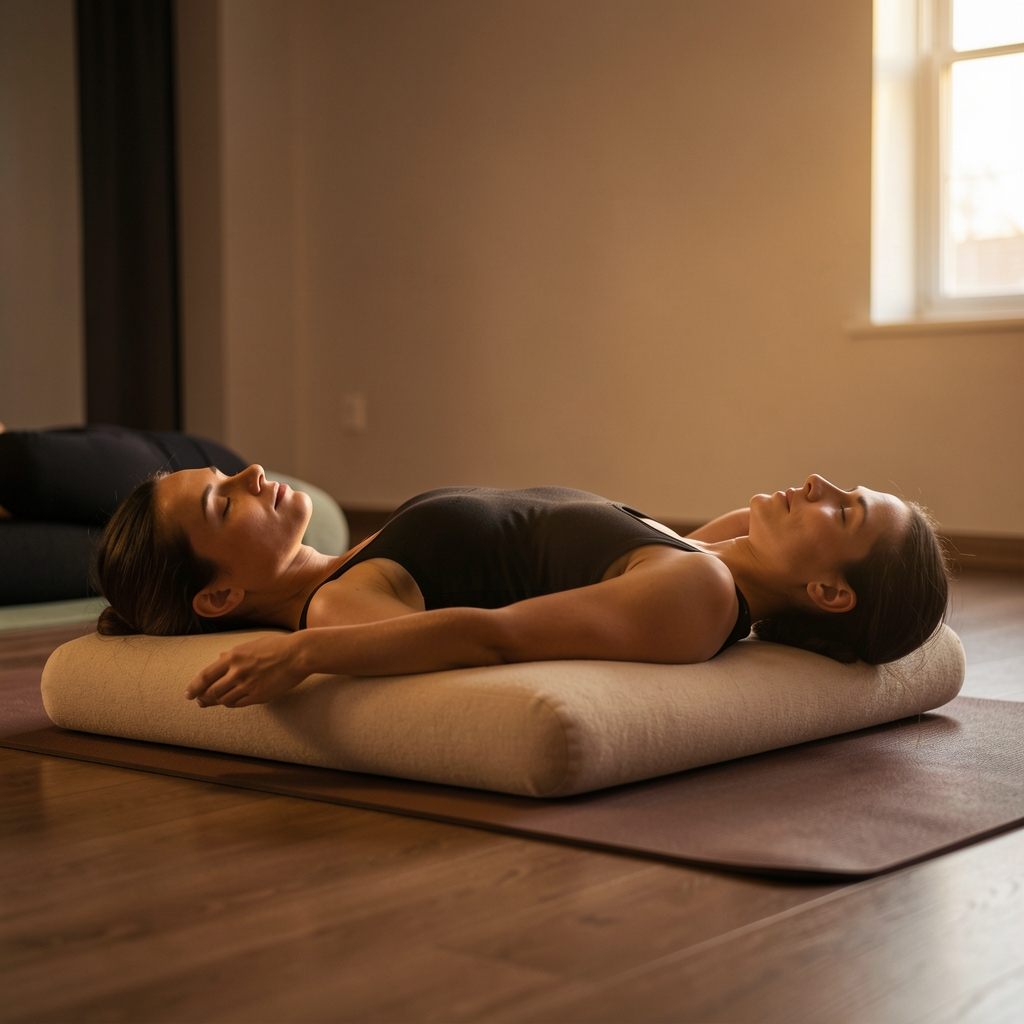
A floor-based variation uses a rolled blanket or a bolster placed horizontally behind the shoulder blades. Lying supine over the prop, the practitioner allows the weight of the chest and shoulders to rest into the extension, with the arms extended out or folded over the chest. This is, in its structure, a restorative variation of a backbend — one of the positions in which the body is asked to do nothing more than yield to a mild arc and breathe. Five minutes in this position addresses the thoracic region in a way that no amount of deliberate muscular effort achieves.
The neck and shoulder girdle do not exist in isolation from the thoracic spine. The tightening of the upper trapezius, the levator scapulae, and the suboccipital muscles that characterises a day of screen work is directly connected to the postural patterns of the thoracic region. Seated stretching that addresses only the larger spinal movements while ignoring the neck and shoulder complex addresses only part of the structural conversation.
Neck stretches in a seated position — lateral tilts, gentle forward nodding, slow half-circles — are familiar enough to require no elaborate description. What is often overlooked is the order in which they are performed. Releasing shoulder tension before neck tension tends to allow greater movement at the cervical spine, because the upper trapezius, which restricts cervical lateral flexion when tight, has already been addressed. A brief shoulder roll sequence — circling the shoulders slowly backward — followed by lateral neck tilts produces a different result from the same neck tilts performed first.
This ordering logic — attending to the supporting structures before the target structures — is one of the defining principles of sound sequencing. It applies to the neck and shoulders as much as to the hip flexors and hamstrings. The body is a system of interdependencies, and a sequence that respects those dependencies will consistently produce more movement with less effort than one that treats each body part in isolation.
The question of how often to interrupt a working day with seated stretches is, practically speaking, a question of architecture. A person who works at a desk for eight hours has, theoretically, many opportunities to introduce three-to-five-minute stretching intervals. In practice, the friction of initiating any interruption to concentrated work means that those opportunities are seldom taken without a deliberate structure in place.
A reliable structure is simpler than most people assume. A reminder set at ninety-minute intervals is consistent with published research on ultradian rhythms — the natural cycles of focus and relative unfocus that occur through the working day. At each reminder, a three-movement sequence (twist, side bend, thoracic extension) covering three to five minutes re-establishes the spinal awareness that the preceding session of concentrated work has gradually eroded.
The cumulative effect of this practice across a working year — perhaps two hundred working days of five or six such intervals — is not measurable in any dramatic sense. What practitioners report is a gradual reduction in the awareness of end-of-day spinal fatigue, a greater ease in maintaining a considered sitting position during the working hours themselves, and a reduced sense of the back as a site of tension to be managed rather than a structure that supports movement. These are not large claims. They are the modest, reliable returns of a modest, reliable practice.
For those approaching yoga for the first time — or returning after a long absence — seated stretches occupy a particularly useful position in the available entry points. They require no specialised equipment, no particular clothing, and no prior flexibility. They can be performed in the conditions of ordinary life without clearing space for a mat, and they introduce the fundamental yoga principles — breath coordination, attention to alignment, graduated entry into range — in a context that feels familiar and manageable.
A beginner who has spent three weeks performing seated stretches at a desk has, in practice, begun a yoga practice, even if they have not attended a class or purchased a mat. The core habit — of bringing deliberate, breath-coordinated attention to the body in motion — is in place. The transition to a more formal mat-based practice, when it comes, is a natural extension rather than a departure from something unfamiliar.

Tobias writes on posture, movement efficiency, and the practical integration of flexibility routines into working life. He has practised yoga for eight years and holds a postgraduate qualification in human movement studies.
More from this journal →